I was young when I first realized that my biracial existence inhabits liminal space.
We piled into the sticky church van, and left the Californian mountains where I’d spent a week at an Asian American Christian summer camp. It was my first experience at a summer camp, my first experience with a large group of Christians, and my first time exclusively surrounded by other Asian Americans. As we drove down the mountain, away from late night campfire worship songs and Bible stories I’d heard for the first time in my life, a friend in the van turned towards me and announced, “You should’ve heard how some of the boys talked about you in our cabin last night. They are obsessed with mixed girls like you.” I could tell he thought the comment was something I should be happy about, but all I felt was the heat rising between my skin and cheekbones.
Years later, thinking about that comment would make me feel small and shriveled up inside. It weaved itself into everything. It was clear that being obsessed with “mixed girls like me” meant being obsessed with the power of whiteness more than anything. I tell a friend about it, but she asks why I’m upset and making things about race, and claims she would be happy to have the attention—however it comes.
Even before I knew his name, white supremacy was waging a war around me and within me.
Without any formal training, I learned to resist my Koreanness like I was on a strict diet. I cut things out, hid what felt most like home, brushed and beat the wild out of my mixed hair, and said no to things I’d always loved. I tried to starve the Imago Dei in me.
It took many long years before I began to realize that my biracial body was a beautiful bridge of existence.
Head on over to The Mudroom to read the rest of the post!
The first day of spring was the color of dust and stone this year. That morning, I backed our minivan out of the garage under a continuous cloud stretched across the sky, a barrier between us and the warmth of the sun. The skin around my eyes was puffy and pressed against the plastic rims of my glasses like pillows, reminding me how turbulent the last night of winter was. Despite the mercies of a new morning, I woke in the aftermath of my own storm. There was wreckage to clean up, things to mend.
I drove my daughter to preschool and looked forward to being back at home in an empty house. Outside our window, we passed the same unremarkable strip malls we pass every time we go this route. Their homogenous messages blurred into one. We passed beige fields and rows of trees that remain thin and naked, their branches reaching to the sky like bitter fingers.
Don’t they know it’s the first day of spring?
It’s easy for me find beauty in shades of gray and layers of fog. I am not afraid of the melancholy of cloudy days, of bare brown tree limbs, or the visible effects of a long winter.
But today, all I see is the litter of plastic bags tangled among the tree trunks.
Have there always been so many?
There’s trash wrapped around the foundation of almost every tree I see. The grief I feel wraps around me as well.
I’ve been passionate about racial reconciliation for years, but engaging in it exhausts me. Since I was a little girl, I’ve thought about the way cultures collide. I’ve seen the effects of those collisions up close. I’ve lived them. My own body feels like a collision of worlds, of ethnicities and cultures, of the East and the West, of racial distinctions made with the intention to separate and classify. If I try to ignore racial reconciliation, I attempt to ignore myself.
But engaging in it is not a calling that makes me feel alive. There’s no arriving or hustling that fits into the work of it. My heart beats faster for it, but it’s lonely and heartbreaking and I have no choice but to face it.
Racial reconciliation isn’t something anyone in the church should be able to choose to be apathetic to. And yet, there are many who believe they don’t have to engage because they aren’t feeling it and weren’t born facing it. It’s a flat-out privilege for anyone to say they aren’t feeling itand it’s not their thing.
I wonder how many people weren’t feeling it as they watched their neighbors leave homes with a suitcase of belongings and a yellow star pinned onto their clothes.
Don’t they know we’ve always belonged to one another?
The last couple of months, I was knee-deep in writing about racism for a project I was a part of. I was hopeful at times, comforted and riled up as I honed in on Jesus’ ministry of reconciliation, but terrified to hope for anything in the world I know. Writing about such a huge topic with such a tiny and inadequate space for the words was daunting, and I came home from the library where I worked and cried often.
The lament I felt as I re-read books, found new ones and tried to write anything worth anything, felt as heavy and ridiculous as wearing a mink coat in the summer. I would rather not wear it. I would rather not be a person who wears a winter coat and tries to get others to wear one with me while they are trying to enjoy their ice cream.
We had a few unusually warm days this past winter. They were so warm that buds showed up on some of the trees in our backyard. After the most recent tease, winter came back with a vengeance. I walked through our backyard covered in ice to marvel at the way winter has the power to silence things. It was eerily quiet but it felt like someone was laughing. The buds were completely frozen, their tender hope stopped cold.
Engaging in racial reconciliation as a woman of color in the world, and in evangelical circles today, feels like being a tender bud trying to survive Winter’s constant comebacks. There’s hope and there are new mercies every day, but there’s still so much silence and cold. When someone says they are scared to be too bold about racism for fear of scaring people away, we all know which people are the ones everyone is most worried about scaring away. What about those of us who are just trying to keep one bud alive in a world frozen with the power of winter?
Isn’t anyone worried about scaring us away?
Do they know how many times we’ve wanted to leave already?
The calendar says that spring is here, but I still see the bags littered among bare trees. I cannot ignore them. I refuse to ignore them.
Will anyone else notice the trash we’ve all left on the imago dei? There’s wreckage to clean up. There are hearts that still need mending.
Yesterday the clumps of unremarkable leaves that line the side of our front walkway were suddenly sprinkled with periwinkle. Our Woodland Phlox had begun to flower. I am struck with how startled I was to see them again. Although I’d become tired of the plain brownish-green stumps of plants they had been for months now, it’s as if I had forgotten the beauty they were capable of.
Today, the flowers on top opened and there were even more pops of periwinkle sprinkled across the plant like pinky promises. Their modest but sure arrival was begging me to pledge to notice them when they fully bloom, and believe they were always on the way, even when I couldn’t see their reality or imagine them last month.
After the joy of the first snow of Winter early on last season, I spent months wishing for the end of it. After weeks of gray-skied, lip-cracking, static filled days, I became decidedly weary of Winter and waiting, quickly forgetting what Winter was working hard to bring about again.
When Spring finally spreads through our neighborhood, noticing is uncomplicated. The birds sing wildly in the now early morning light, and the Crabapple tree in our front yard lets loose a million white flower petals to the wind as if our streets were made for a wedding celebration instead of the everyday grind of commuters, yellow buses bringing hungry kids home, and mail trucks filled with bills and impersonal ads. It’s as if Spring has perhaps always been and exists on it’s own, unrelated to the long, mostly unseen work of Winter.
It’s not just the seasons. I feel this way about the character God is growing within me and my children when there are months without any evidence of it despite so much intentional work. I feel this way about longing for racial reconciliation within the church. I feel this way about the important relationships in my life that aren’t in the places I hope for them to be. I feel this way about my aging body when changes seem slow to show, despite work and desire to grow and become healthier and stronger.
The more I begin to recognize the way that what’s seen and unseen are two necessary parts of a whole thing, the more contented and convinced I become, no matter the season. The more I look beyond the surface of what is seen, the more I see the world around me, even the day to day mundane and the seemingly still unchanged, with hope and wonder. Click to tweet The more I surrender to the way that each of the seasons is irrevocably connected, the less I try to pull and pick them apart from one another, resisting their bond.
I often think about the way Jesus was prophetically described in Isaiah as someone who would be tender, lacking in physical beauty or majesty, melancholy, rejected and disliked. His family, friends and followers were asked to see beyond what was seen when he was living on Earth, from his humble birth to his death on the cross and everything he did in-between. His description seemed opposite of what anyone would ever expect while knowing who and what He truly was.
The memories of past Springs remind me that our little Phlox flowers won’t stay for long. The birds will finish their busy morning songs and our Crabapple tree will lose it’s snow-white flowers one by one. Most celebrations in life are short and sweet no matter how we hang on. The Phlox petals will fall back to the earth they rose from, leaving plain green plant leaves to stay throughout the rising heat of Summer. If I pay attention, I know I will be asked to remember every part of their imperative rhythms as purposeful; and if I listen closely to the voice that matters most, I will be wooed towards greater faith and sight until they rise again.
Almost two weeks ago, we met our little girl face-to-face for the first time. I have been struggling to put to words all of the emotions I have about our time. Our week in
Seoul was abundant with remarkable and sundry gifts.
We arrived in the evening on a Saturday. It was cold, and as we weaved away from the airport and towards our hotel, I began to fall in and out of sleep. In pockets of semi-wakefulness, we tried to make small talk with our driver. Korea greeted us with lights along the busy highway and fireworks in the distance. When I woke fully, our car was surrounded by people, traffic and the flashing lights of Korean police cars. The Korean president had recently been impeached and we had arrived on Korean soil during a historic national moment. Simultaneously, the moment felt historic for our little family and my own heart. Despite the heaviness of jet-lag and confusion that pressed on my
eyelids and clouded my mind, the energy and excitement of the city was clear and palpable. Later that night, we fell asleep 18 stories high, listening to the sound of Korean protestors. They protested by singing national songs in unison. The sound of their voices was beautiful. We’d been warned of the protests but assured by hotel staff that Korean protests these days are safe, and resemble something more like a festival. That night, I sensed that the Korean people know lament, hope and their commitment to one another in the midst of both things.
Most of the week, Matt and I were on our own, taking the city in, enjoying the food and culture and being together. It was a forced babymoon. We went to Korea to meet our girl but the way the meetings were set up left a lot of open space. We walked all over the city and rode the subway from one district of the city to another, taking everything in.
There’s something about exploring a city that makes my heart come alive. It’s been years since Matt and I have worked or lived and travelled internationally together, and I’ve often wondered if those experiences were just experiences of the past. But in Seoul, it was such a gift to realize that we are still a great travel team and still do really well navigating a foreign city together.
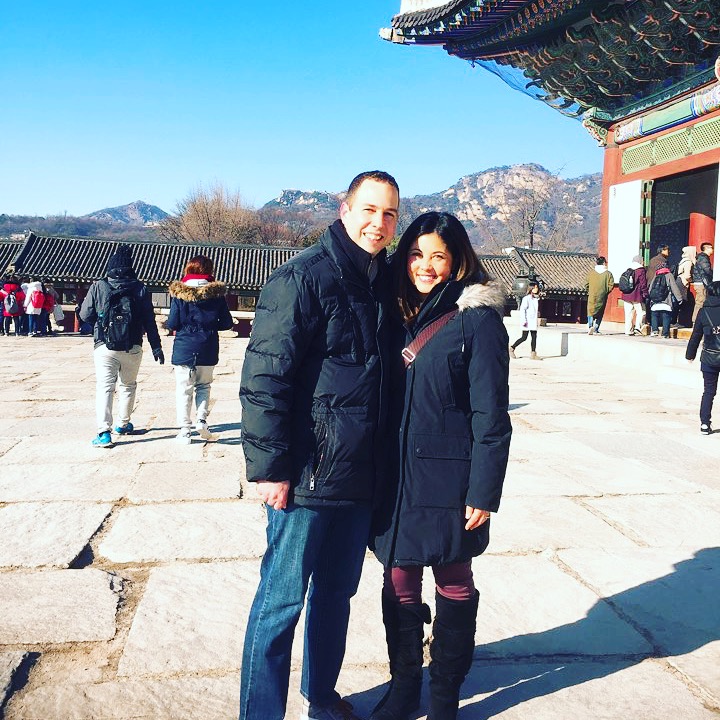
At Gyeonbok Palace
There were 2 meetings set up with our agency: the first to meet E and the 2nd for more time with her. I was so nervous before our first meeting. There were 16 other adoptive parents there while we were. They split us up into two groups and one group had their meetings in the mornings while the other had them in the afternoons. On the first day, along with 7 other couples, we entered a large meeting room. The chairs and tables had been stacked and placed around the edges of the rooms. The room was full with us, our children, their foster moms and agency staff. A plastic tub of toys was laid in the middle of the room for the children to play with and there were snacks and bottles of water by the door.
It took me a minute to find our E, but when I spotted her I immediately recognized her profile and her foster mother standing next to her from pictures we had been sent. For a moment I was frozen. I had imagined this moment so many times and could hardly believe we were standing in the same room as her. She stood close to her foster mom, with rice crackers clenched tightly, one in each hand. We tried to talk to her, but she walked away from us, timid and uncertain. When we squatted down close to her, she would look at us out of the corner of her eye, not wanting to meet us head on. I honestly didn’t expect any more than that, knowing how confusing the meeting must’ve been for her. I felt helpless trying to connect with her in such a large room full of distractions
and such little time. Her foster mom told us that of that group, E was probably he most reserved, quiet and soft-tempered. Our first impressions definitely matched the description. She also told us that E loved snacks and in the end, it was the snacks that first helped build a bridge between us. We gave her what looked like a Korean version
of Goldfish crackers and then asked her if she would share one with us. Sharing food builds bridges, doesn’t it? Towards the end of our first meeting, Matt got her to smile and laugh; witnessing those moments of connection were like witnessing the moment when a child receives a brand new, bright red balloon. I loved seeing a new side of my husband as he reached out and gently tried to connect with his little girl. We played peek-a-boo with her and discovered that she loved looking out the high-rise windows and pointing at all of the cars, buses and people down below. She is delightful and beautiful and it was clear that she has been incredibly loved.
Before meeting E, I wondered if it would feel strange to want to be close to her or love on her. With our boys, I’ve known their expressions and their scent from day one of their lives. I was afraid it would feel different with our E. And yet, in the three hours we had with her, I can confidently say that while some moments did feel strange and new, the desire to know her and learn her and draw close to her was no different.
There we were in this large meeting room: adoption agency staff, Korean foster moms, and adoptive parents from all over the world. We were a global team brought together in time and space because these children are worth so much. The Kingdom of Heaven belongs to them.
On our second meeting with E, she recognized us right away but still seemed a bit reserved. We had picked up some snacks and some of the candies we remembered she liked from our first meeting. This time it was easier to get her to giggle and interact, and we saw a bit more of her feisty side. The hour and a half flew by and before we knew it, one of the agency staff was telling us it was time to go and to bring our children back to their foster moms. It felt like someone had given us a present to open and then took it
back after we’d unwrapped it and had the time to imagine this new gift as a part of our everyday lives. It was so strange to watch E get all bundled up and leave the room with her foster mom,not knowing how many more days would pass before we would no longer have to say goodbye. The room gradually became subdued as each of the children left. All of us adopted parents were left to collect our emotions, fears and longings and step further into a fresh time of waiting. We waited before this moment, some of us for years, hanging on every small glimpse or piece of the reality of who our child is: pictures, well-baby check updates, anything. Now we wait with tangible evidence and experience
of who our child is and who it is we have been waiting for and still wait for.
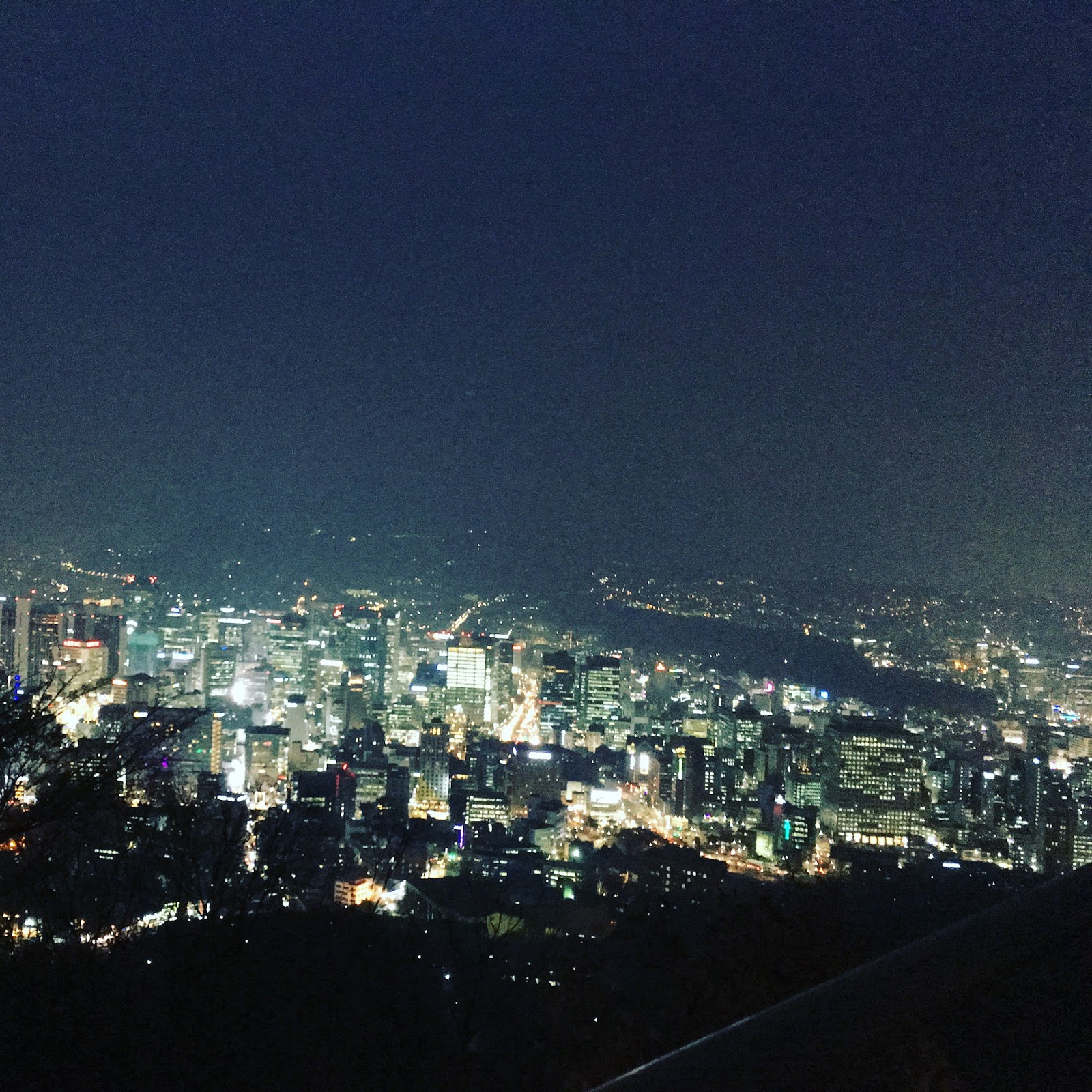
Seoul’s city lights from Namsan mountain.
The days since we have been back have been odd.Here we are in what we’ve always known as normal, and yet, not the same.Our time in Korea feels like it was a dream. Korea pulled at our hearts.God welcomed us to draw near to him afresh through this Land of the Morning Calm.And now, not only does this land give landscape and color
the stories of my roots, it’s now the first land of our daughter and always will be. It is the place where we first laid eyes on her and saw her smile. It’s where we saw her walk and run and grab at Matt’s eyebrows.
More than ever, I am convinced that God’s hospitality and heart exist the whole wide world over; he has so much to offer us in lands and places and peoples we have yet to know.



 tashajun.com