After inspecting the skin on his forearm, my son looks up and announces, “My skin isn’t white, but it’s not as dark as my friend Sam’s.” I nod in affirmation. He cocks his head to one side and asks, “So what color am I?”
As a mixed race, transracial, part Asian American family, it’s impossible to avoid the subject of skin color, race, and ethnicity. Noticing difference has always been normal for me and my kids.
Whenever we can, we affirm our kids’ noticing skin color and tone. Whether it’s their own, a friend’s, a stranger’s, a toy’s, or a book character’s, we talk about what we see and note how beautiful the variations are. Every moment of noticing is an opportunity to tell the truth.
We can’t celebrate, know, or grow alongside what we pretend not to see.
In college, I did a Bible study with a group of friends about the life and ministry of Jesus. On Tuesdays and Thursdays, sandwiched between two afternoon classes — “Literature of the Holocaust” and “Blacks and Jews in the National Imagination” — I walked to a local coffee shop and spent time poring over Matthew, Mark, Luke, and John. For hours on those days, my mind was filled with stories of systemically oppressed people groups from the books in my literature classes and the stories of Jesus’ life and ministry told through the gospels.
One particular afternoon, in-between sips of my coffee, I read a paragraph in the study that emphasized how Jesus might’ve looked. It said that based on where He was from, He likely had very dark skin, and course, black hair, like me. Before this, I had never heard anyone describe Jesus as anything other than white. As I considered His face and skin, I cried right into my coffee cup.
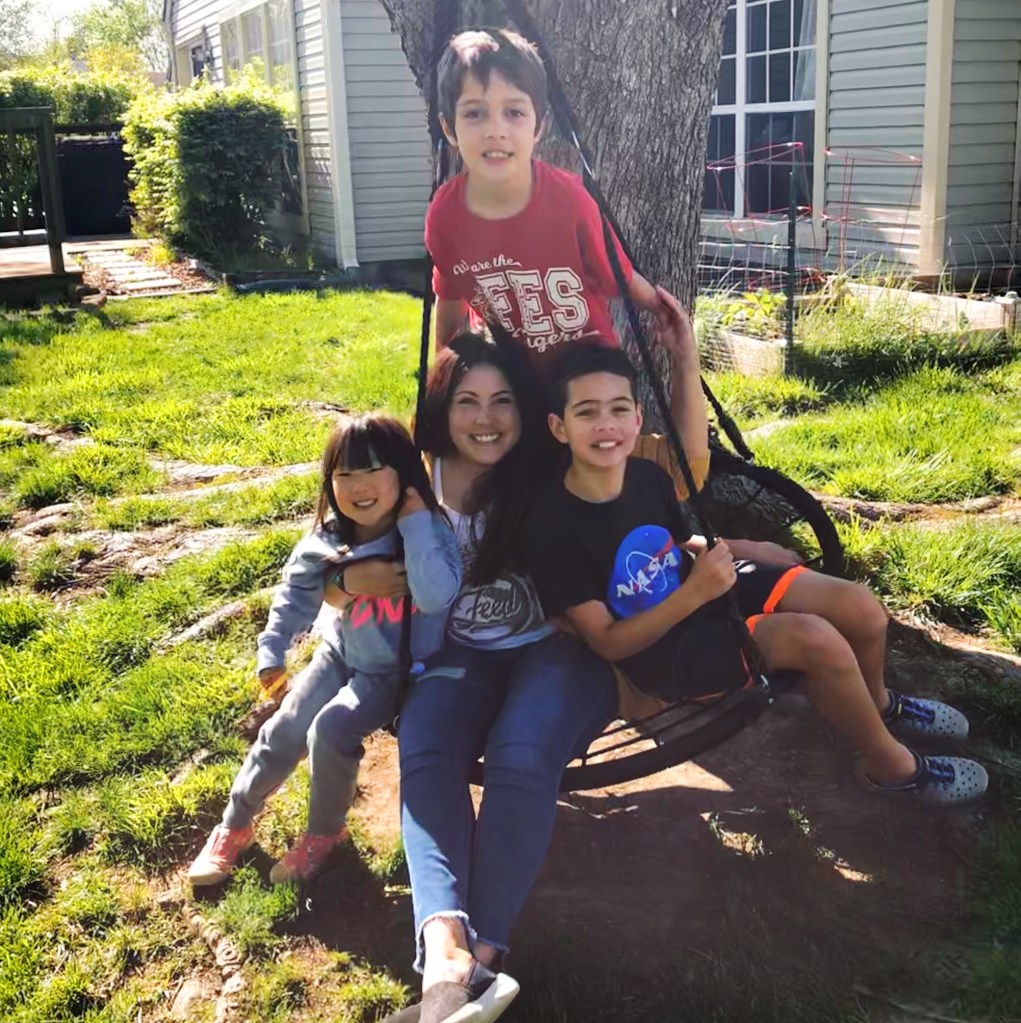
Today was flowers and wind. It was gray sky and fighting over legos and laundry. Today was empty and it was abundant. We said I’m sorry. I asked how long? We remembered ourselves when the sun came back out. Today was 2.23 miles and it was not enough. Today was squishing onto this spider swing and smiling for the camera before the afternoon slipped away.
For the last six weeks, the farthest I’ve gone from my home is about half a mile. Most days after lunch, my family and I take a quick walk around our tiny neighborhood loop. We’ve been sheltering-in-place, like much of the rest of the country, and these daily walks have given us some stability while the rest of our lives float in uncertainty.
The house behind us has a row of daffodils standing at attention like bright yellow soldiers who guard a white picket fence. There are light pink magnolias on a side street close to ours, and lavender crocuses surprise us at the base of mailboxes and tree trunks.
On our walks, I see people in the neighborhood I’ve never seen before. We silently obey the social distancing rules, taking turns shuffling our bodies into the street so others can have the sidewalk while we pass. I see weariness in their eyes — even the cheerful ones. No one looks put together. The loss of our clean-cut hair confirms this common understanding that we’re all hanging by a thin thread.
The news today predicts more job losses, more death, more waiting, more disparities, and more discouraging numbers than I can keep count of. I cry with gratitude when I see photos of nurses and doctors whose red marks and indentations, paths of stress and sorrow, line their faces. My friend with an autoimmune disease, a nurse, texts me to say how scared she is before heading into a COVID unit, and the fear I feel for her is visceral. I feel a gash in the face of hope when I read vitriolic accusations online, get a message about someone else who’s lost their job, or feel the anxiety rising in my Asian American body when I am in public and don’t know how a stranger will respond to my existence beside theirs, like Grace wrote about here.
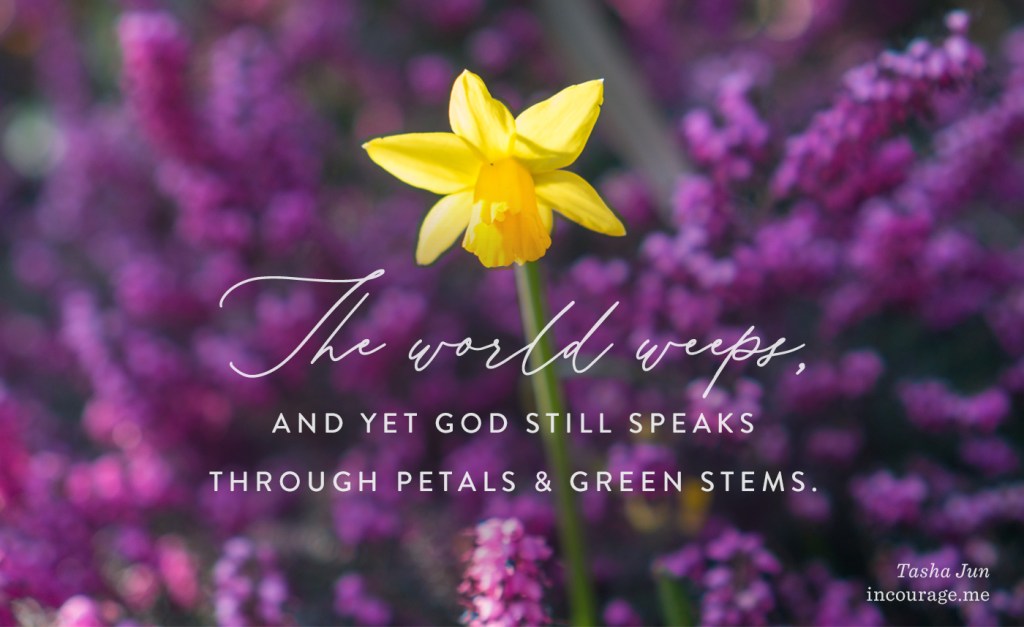
The world weeps, and yet God still speaks through petals and green stems.
Every year between October and April, I manage to forget how beautiful spring is. But this year, it’s more than my yearly winter amnesia. The flowers this year seem audacious. The weight of COVID-19 hasn’t kept them from rising. These gentle symbols of resurrection stand straight up to salute the sun.
My kids bring their own cameras on our short walks. They take note of dandelions and find funny faces, hairstyles, and personalities in the shapes of the trees. We observe tiny gray fish in the neighborhood retention pond, witness a duck take flight from the water, and look at the greenish pond scum lining the rocks by the water’s edge. We’ve become a family of tourists in our own neighborhood. We are thirsty for wonder.
On my first trip to Korea as a child, what I was most excited about was Tteokguk. I knew the rice cake soup my mom made for me came from this country, and I imagined getting to eat it every day.
From the moment we arrived and jumped into our first taxi, I sank right into being there like a little girl who had been a long way away from home. I studied the brown beaded taxi-driver’s seat and the white covering underneath it. I listened to the sound of his jaw chomping on a piece of chewing gum, and watched the way his lips smacked from his profile. I noticed each time he looked into the rearview mirror and furrowed my brow, trying to grasp the words he exchanged with my mom. I remember how I felt like I should know what he was saying and what my mom was saying in return, the meaning like something I was about to say, but forgot for the moment.
Korea has always felt like that to me: like words and recipes on the tip of my tongue, forgotten and just out of reach, removed for the sake of survival everywhere else in the world.
That was the summer teenage boys spit on my sister and me. We were walking along Haeundae Beach. I had a little plastic light-up ball that my parents had bought me the night before from a street vendor, and I proudly carried it like a symbol of my connection to other Korean children I had seen.
They spit on us from behind, laughing and using sharp-edged words I didn’t know. I remember wiping the moisture from the back of my calf, and trying to comprehend what had happened. Later my mom and dad eventually explained that they had spit on us because we were biracial Koreans.
Despite my love for Tteokguk, I didn’t know it was the soup Koreans ate for Lunar New Year until I was much older. I just knew I loved it when my mom made it and that I couldn’t get enough of spoon-searching for the white ovals in my bowl. Before that first trip to Korea, I thought that love was enough. But no matter how many soupy rice cakes I consumed throughout my childhood, I was missing just as many details, if not more, that a million other Koreans knew. At some point I began to believe these missing details disqualified me as a real Korean girl.
I made Tteokguk to celebrate Lunar New Year last Saturday. It’s the second or third time I’ve made it on my own, and it gets better each time. But each time I stand over the pot, measuring the guk-ganjang and letting the tteok sit in a bath of cold water, I hear whispers suggesting that I’m a fake. It’s like those high school boys in Haeundae are still standing behind me, looking down on me, uttering derogatory comments at me and my claim to being Korean.
My kids sat around the table, excited at first, remembering how the white slices of chewy deliciousness symbolize a fresh start for the new year, and how they resemble the moon.
Then, one of my kids complained about the egg slices, another about the green onions, and one of them would only drink the broth.
I sent my mom a picture of the soup, hoping that she would approve what it looked like, and wouldn’t respond with questions about why it looked so dark (like last year when I used the wrong kind of soy sauce), or if I’d forgotten another important element.
Home happens easily for some of us. Traditions are passed down on easy-to-read recipe cards and keeping them takes little effort. We make and celebrate the things that come naturally without thinking that there’s something we’ve forgotten. But some of us are born from a womb of cultural loss, and we have to work hard to recover from those losses.
I heal a little bit more each year, each new attempt at getting the Tteokguk right. Celebrating Lunar New year feels like one year after another of restoration, of introducing tastes and textures to my own kids and battling with them over the details of their heritage that float in soup bowls: the green onions, the roasted gim, and the bright yellow sesame-flavored slices of egg. Every year I work to push back against the lie that says I’m not Korean, and the lie that tells me to give up and assimilate. I won’t find this work in a list of familiar ministry opportunities at any church I know of. But, I know I need to give space to this. I know that it’s good and right to show my own kids how to taste and see what no one should be allowed take from them or diminish for them: God’s image pressed into every part of their cultural identity. This is kingdom work too.
Here I am in my first pair of glasses that were made with more than one kind of nose bridge in mind. I didn’t expect to feel emotional about it. For the longest time, I thought glasses always slid down my nose because I was clumsy, or because my face sweat more than others. I mean, I have a blanket of “thick, ethnic hair,” after all. Basically, I thought the frames never fit well because something was wrong with me.
Last week, my photographer friend, Joanna, was telling me about the way photography was developed to accommodate one skin color. I read about it this morning. Read this NPR article or google “the Shirley card” if you don’t believe me.
Having glasses that fit, bandaids that match skin tone, and photos that don’t make your skin color look weird might seem like small inconveniences. On their own, that’s what they are. Many of us just live with it. But built into a lifetime, and built into the fabric of a society’s foundation, these “inconveniences” are part of a much weightier message of “less than.” A system. And letting a “less than” message live on and thrive as a system, is the way that things like internment, slavery, and genocide occur under the world’s watch, and the way that mass incarceration, children in cages at the border, and language that labels people made in the image of God as an “infestation,” happens on our watch.
This isn’t about feeling pity for the right fit of glasses. I don’t want any of that. This is about noticing. It’s about seeing the system that still exists and resisting it. It’s about fighting for people instead of the color and design of a Starbucks cup at Christmas time. It’s about believing God when he said that he made EVERY man and woman in his image, and refusing to ignore and go along with the systems that are essentially saying he lied about that.
Having frames that fit my face may seem like a small thing. But the truth is, it speaks to my worth, and that’s no small thing for any of us.





 tashajun.com