The Tender Side of Conflict

Originally written for Coalesce Magazine
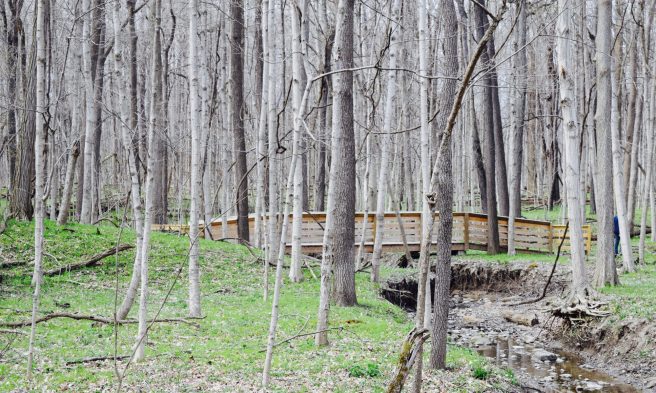
I spent a season avoiding my Bible when I was in college. It wouldn’t be the first time I avoided my Bible, or God, for that matter. That long season of avoidance felt like the dark early evenings of Winter and persistent static in my hair. My soul had become dry. Instead of reaching for the only thing that would quench it, I ran from it for fear of confrontation. 

Months before, I had decided to continue on in a relationship that I knew I needed to let go of. It was a comfortable place for me, but one that wouldn’t allow me room to move forward in the ways God had invited me to step out and trust Him in. So, I politely declined by way of ignoring and left my Bible under a stack of class books. It sat there patiently and persistently present, holding up all of the weight of my evasion. 

I was afraid to engage in conflict with God.  

Growing up, conflict was something scary. I became an expert at circumventing it. My earliest encounters with conflict showed me that those who engage in it don’t always come out of it for the better. Conflict sounded like the extremes of volume and silence: words screaming loud like scissors and then cut short after an abrupt silence on the other end of the line when someone hung up. It felt like running into dead ends and walking on eggshells.

Conflict made me question the ground I stood on. It taught me to tip-toe around the questions I was too afraid to ask out loud: Am I still loved when the face looking back at me is scrunched up and hot with anger?  How do I find footing and make the room we are in stop feeling unsteady like the early tremors of a coming earthquake? 

After months of walking by my Bible and looking away, one morning, I stopped. My desperation pushed me to reach for it. Days before, I ended the relationship I had been clinging to. Like a prodigal daughter, who became so hungry and was now undistracted with nowhere else to turn, I opened it again. I was ready to go back, no matter the reprimand and shame.

Instead, I found the book of Hosea.

Through that book, God spoke to me with passion and kindness. I pored over the book and read these verses in Hosea 2:14-15, and wept, “But then I will win her back once again. I will lead her into the desert and speak tenderly to her there. I will return her vineyards to her and transform the Valley of Trouble into a gateway of hope.” The words were for His people in another time and day, and they were for me. I learned about the way God used the prophet Hosea’s life calling of being married to a prostitute, to show His people the way he felt about them and how he would pursue them despite everything they had done. The confrontation and conflict were necessary guides on the path of relational restoration and redemption. There were passionate words used in the exchange between God and his people, but there was also tenderness, pursuit, forgiveness, and hope.

A few years later, during training for a job, I learned about healthy conflict resolution and was given tools for how to engage. It was eye-opening to learn about how the language and posture I used during conflict would either help bring resolution or make things worse. The right tools helped me learn to engage when I didn’t want to, and reminded me that the end goal of conflict is to bring greater depths of understanding, love and intimacy. I thought about the way God had pursued me by engaging in conflict with me, not because I was unloved, but because of how much more I needed to know that I was loved. Conflict is still hard for me. I don’t run and hide like I used to, but now when I feel those tendencies, I try to remember how far God’s tenderness has brought me. His continued pursuit of me through conflict has made me confident that the ground we stand on is firmly fixed with His gentle and determined love.

Think about what conflict looked like and sounded like when you were growing up.  How does that affect the way you approach conflict with others and with God now?

God’s love for you is perfect. He is tender, passionate, intimate, steady and good. How does knowing those things change your willingness to engage with him honestly, no matter the conflict and confrontation it may bring?

The Destiny in Our Daydreams

She scurried over to the rice cooker and opened it. Using a rice paddle to scoop out a few grains of day-old rice with her right hand, she then picked them off of the paddle with her left, squishing them together between her slender thumb and forefinger. I watched her move quickly and silently, her dark eyes focused and on task.

I am the daughter who was ever seeing but never understanding. I listened to stories and yearned for more answers. The barrier between us has been hard, at times as unyielding as concrete. It’s thick middle fortified by cultural misunderstanding, language lost in translation, hidden stories, the grief of lives stolen and the gift of lives given.

Moments before she had shifted her focus towards the rice cooker, I had rolled my eyes and declared we couldn’t go to the event we’d been invited to. The gift that had been carefully picked out months before couldn’t be wrapped because we couldn’t find tape anywhere in the house. Why was there always some needed item missing? We were already going to be late as it was, and at the time, I couldn’t fathom attending the event without a proper gift, wrapped like all the others would be. I didn’t want to be the one who stood out again, who didn’t know the protocol again, who might have to explain not having something as simple as a roll of extra tape on hand, because so much of life was busy trying to figure out how to fit in as the multicultural family we were.

Read the rest over at (in)courage

Glorious Weakness: A Book Review

I wrote my first story in elementary school. My teacher encouraged us to think about a snapshot or memory of our lives and make it into a book. I remember sifting through ideas with my parents at dinner, imagining what I would draw and the words I would piece together to tell my story.

My parents shared my birth story with me often as I was growing up, so frequently that I thought I remembered the entire ordeal myself. This was what I chose to write my first story about. I was born too early, and once I was born, according to my mom, I barely survived. 

Every time I shared this story, listeners quickly moved on to how strong I must’ve been, to have survived. I learned quickly how uncomfortable we all are, myself included, with weakness. We want to flip the card as quickly as possible. We want to answer for it and find a weightier reason for it.  

I started telling my birth story in a way that didn’t make anyone too uncomfortable. I made sure to focus on the miracle of my survival and how my underdeveloped lungs grew against odds. As I got older, I didn’t talk about how I still sometimes felt so small that I was hanging on for dear life inside. Until recently, I didn’t tell people about the way I’ve felt closed in by the weight of not knowing how to embrace my God-given identity as a woman and a biracial Korean American, just like the way I began life: enclosed in an incubator and dependent, the opposite of confident and strong.  I wrote the story again as an adult, understanding for the first time that weakness is where strength is birthed .

Alia and I met over Voxer, or maybe through She Loves Magazine. Once we started Voxing, I felt like I had known her for years and our conversations there have felt like a breath of fresh air, a place where I can be real as a writer, as an Asian American woman, and as a person who often feels the weight of weakness in a world that is terrified of that description.

I knew that I would love Alia’s book, as I have loved every word she’s written publicly and spoken to me over the phone. Alia is a prophetic poet that isn’t afraid to tell the truth and make room for others with a hospitality that’s rare in the world today. She writes raw, but not just for shock value.

What I didn’t expect was the way God would use her words, masterfully weaved on every page of Glorious Weakness, to speak love to me. As Alia shared glimpses into her own life, from her personal experience of pain, mental illness, church and poverty, I felt God’s love.

I don’t know about you, but I’ve grown weary of the multitude of Christian books out there with empty messages, ones that pass over the pain, only tell stories of triumph, try to convince us that we can live shallow lives, chase small dreams of personal success, and twist Jesus’ call for us to love like he did into an easy, comfortable love.

“Christians lie when we sell a packaged and sanitary way of following God. We offer a discounted gospel when we say it will fix your problems, ease out the wrinkles of your day, give you shiny, full-bodied hair and perfectly behaved children. We wield our Christianity like an omen to ward off hard times. We want a warning sign or someone to blame when things get broken. When children die. When dreams fail. When we are summoned to great and immeasurable loss and the hits keep coming.” (147).”

Many of us need to know that we were never made to muster up our own strength to live and thrive. Many of us need to be reminded that hope lives through the death of our dreams and the confusion that comes when we’ve been sure of our calling and then lost our way. Most of us need to know that love doesn’t cease to be love when things get uncomfortable, and that we can indeed be found no matter where we are. That in our weakest moments, the ones we think would disqualify us, bench us and leave us enclosed, God moves most powerfully.

“I didn’t know my dry and weary bones were kindling for a spirit ablaze with the weight of God’s glory.” (169).”

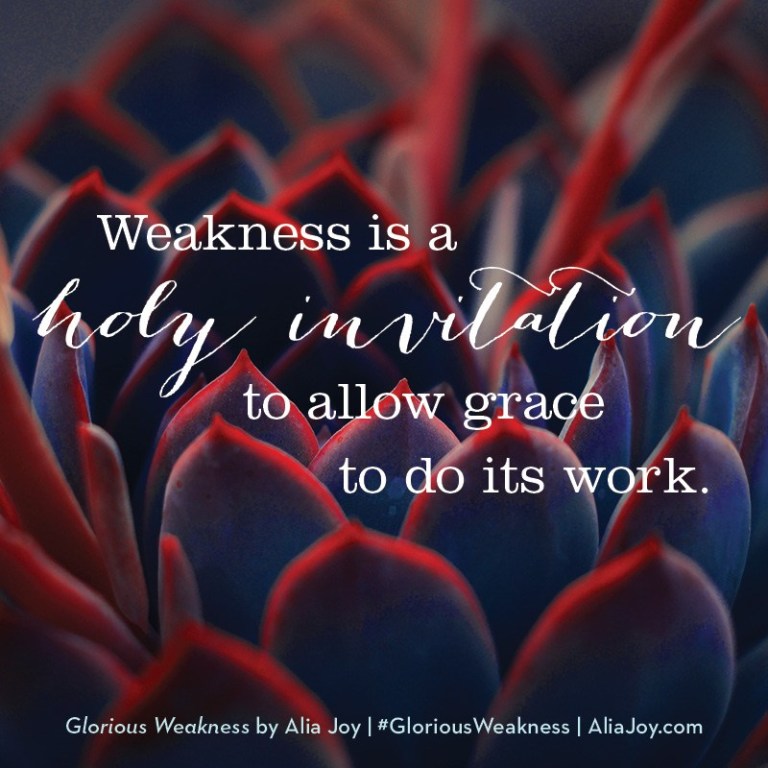
“Weakness is my spiritual gift. In my complete and utter poverty, I give up my illusion of control and my weakness becomes my greatest offering of worship.”  (171).”

Alia’s book launches into the world tomorrow. Don’t miss this book, friends.  This one is for everyone and it’s a message the church and the world today desperately need to hear. Order the book here or here.

Courage is for the Faint of Heart

I rubbed my bulging stomach, trying to appease the skin that was stretched and desiccated, begging me for assurance. We were expecting our first child, and at that point in building our baby registry, my mind was whirling. I wanted to hide from the bright white lights of the colossal store, but they reached into every aisle and reflected their potency from the vinyl flooring. My feet felt like stubs too small for the weight of my body and my son’s growing one. I felt too small for the weight of “shoulds” I had agreed to without a fight.

Ten years ago, at this point, I thought our decisions about everything from sleep schedules to discipline, homemade verses jarred baby food, and whether or not we taught our son to speak sign language along with other needed languages, would determine how bumpy our flight of parenting would begin and stretch forward. Beyond that, I believed that all of our work would ensure our son’s safety, thriving, well-being, and basically, his everything.

Read the rest of the post here.

Lament on the First Day of Spring

The first day of spring was the color of dust and stone this year. That morning, I backed our minivan out of the garage under a continuous cloud stretched across the sky, a barrier between us and the warmth of the sun. The skin around my eyes was puffy and pressed against the plastic rims of my glasses like pillows, reminding me how turbulent the last night of winter was.  Despite the mercies of a new morning, I woke in the aftermath of my own storm. There was wreckage to clean up, things to mend.

I drove my daughter to preschool and looked forward to being back at home in an empty house. Outside our window, we passed the same unremarkable strip malls we pass every time we go this route. Their homogenous messages blurred into one. We passed beige fields and rows of trees that remain thin and naked, their branches reaching to the sky like bitter fingers.

Don’t they know it’s the first day of spring?

It’s easy for me find beauty in shades of gray and layers of fog.  I am not afraid of the melancholy of cloudy days, of bare brown tree limbs, or the visible effects of a long winter.  

But today, all I see is the litter of plastic bags tangled among the tree trunks. 

Have there always been so many?

There’s trash wrapped around the foundation of almost every tree I see. The grief I feel wraps around me as well.

I’ve been passionate about racial reconciliation for years, but engaging in it exhausts me. Since I was a little girl, I’ve thought about the way cultures collide. I’ve seen the effects of those collisions up close.  I’ve lived them.  My own body feels like a collision of worlds, of ethnicities and cultures, of the East and the West, of racial distinctions made with the intention to separate and classify. If I try to ignore racial reconciliation, I attempt to ignore myself.

But engaging in it is not a calling that makes me feel alive. There’s no arriving or hustling that fits into the work of it. My heart beats faster for it, but it’s lonely and heartbreaking and I have no choice but to face it.

Racial reconciliation isn’t something anyone in the church should be able to choose to be apathetic to. And yet, there are many who believe they don’t have to engage because they aren’t feeling it and weren’t born facing it. It’s a flat-out privilege for anyone to say they aren’t feeling itand it’s not their thing.

I wonder how many people weren’t feeling it as they watched their neighbors leave homes with a suitcase of belongings and a yellow star pinned onto their clothes.

Don’t they know we’ve always belonged to one another?

The last couple of months, I was knee-deep in writing about racism for a project I was a part of.  I was hopeful at times, comforted and riled up as I honed in on Jesus’ ministry of reconciliation, but terrified to hope for anything in the world I know. Writing about such a huge topic with such a tiny and inadequate space for the words was daunting, and I came home from the library where I worked and cried often.

The lament I felt as I re-read books, found new ones and tried to write anything worth anything, felt as heavy and ridiculous as wearing a mink coat in the summer. I would rather not wear it. I would rather not be a person who wears a winter coat and tries to get others to wear one with me while they are trying to enjoy their ice cream.

We had a few unusually warm days this past winter. They were so warm that buds showed up on some of the trees in our backyard.  After the most recent tease, winter came back with a vengeance. I walked through our backyard covered in ice to marvel at the way winter has the power to silence things. It was eerily quiet but it felt like someone was laughing. The buds were completely frozen, their tender hope stopped cold.

Engaging in racial reconciliation as a woman of color in the world, and in evangelical circles today, feels like being a tender bud trying to survive Winter’s constant comebacks. There’s hope and there are new mercies every day, but there’s still so much silence and cold. When someone says they are scared to be too bold about racism for fear of scaring people away, we all know which people are the ones everyone is most worried about scaring away. What about those of us who are just trying to keep one bud alive in a world frozen with the power of winter?  

Isn’t anyone worried about scaring us away? 

Do they know how many times we’ve wanted to leave already? 

The calendar says that spring is here, but I still see the bags littered among bare trees.  I cannot ignore them. I refuse to ignore them.

Will anyone else notice the trash we’ve all left on the imago dei?  There’s wreckage to clean up. There are hearts that still need mending.